 by
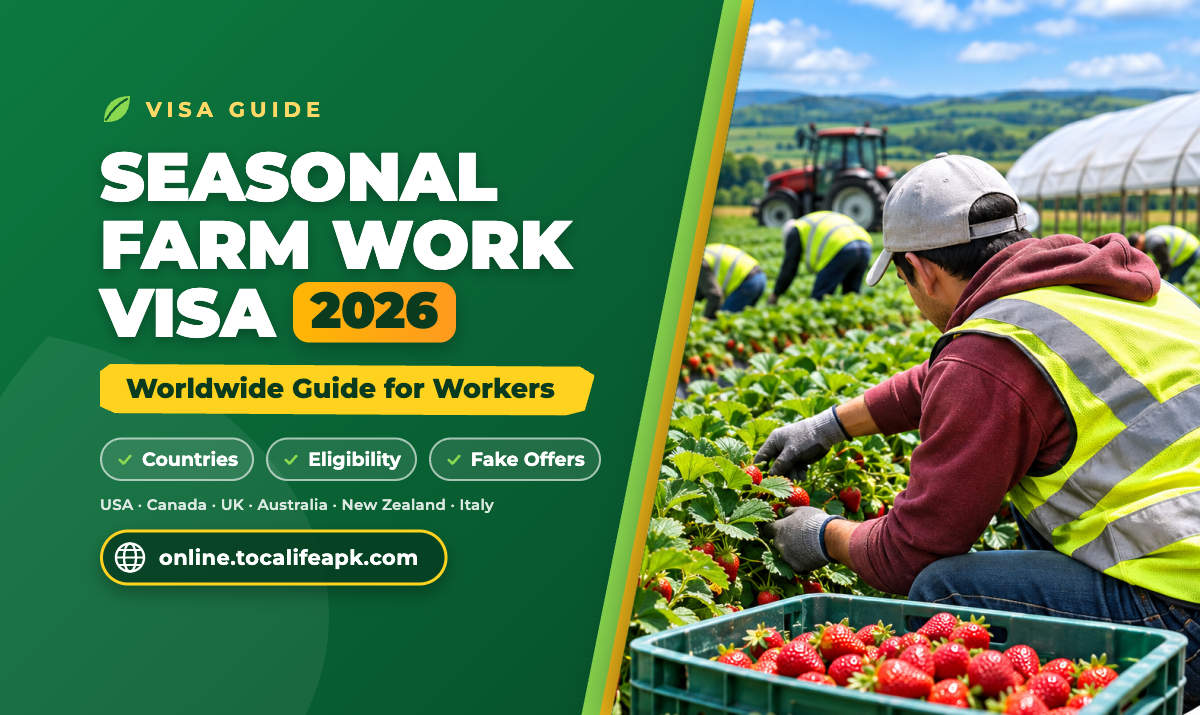
There is no single seasonal farm work visa that works everywhere. Each country runs its own scheme, and your passport decides which ones you can use. In 2026, the main routes are in the USA, Canada, the UK, Australia, New Zealand, and Italy. This worldwide guide shows how each one works, who can apply, and how to avoid fake offers.
Key points
- Every scheme starts with a job offer from an approved employer or operator in that country.
- Your nationality decides which schemes you can use. Some are only for listed countries.
- Seasonal visas are temporary, and most don’t let your family join you.
- Never pay anyone for a job offer or a permit.
What Is a Seasonal Farm Work Visa?
It lets you work on a farm for part of the year, then go home. In most schemes, the employer must show that local workers aren’t available first. The stay is short, and you usually can only work in the job or sector named on your visa.
Seasonal Farm Work Visa 2026: Countries at a Glance
| Country | Scheme | Stay | Who can apply |
|---|---|---|---|
| USA | H-2A | Job-based, up to 3 years in total | Nationals of countries on a US government list. Your employer needs a labor certification first. |
| Canada | Seasonal Agricultural Worker Program | Up to 8 months | Citizens of Mexico and some Caribbean countries |
| UK | Seasonal Worker visa | Up to 6 months in any 10 months | Overseas workers aged 18 or over, with a job through an approved scheme operator |
| Australia | PALM scheme | Up to 9 months | Nine Pacific island countries and Timor-Leste |
| New Zealand | Recognised Seasonal Employer (RSE) | Up to 7 months in 11 | Eligible Pacific countries, with limited exceptions |
| Italy | Decreto Flussi (seasonal) | Seasonal permit, set by quota | Non-EU nationals within the yearly quota. Your employer applies on a set “click day”. |
Rules and numbers change every year, so always check the official page before you apply.
What This Means If You’re From South Asia
Canada, Australia, and New Zealand schemes are for listed countries, and South Asia isn’t on those lists. The UK route is open to overseas workers who get a job through an approved operator, and it has 41,000 horticulture places in 2026. Italy’s 2026 to 2028 plan reportedly reserves quotas for countries including India, Pakistan, Bangladesh, and Sri Lanka. For the USA, check the current government list of eligible countries.
What You’ll Usually Need
- A job offer from an approved employer or operator.
- A valid passport and, in some schemes, proof you’re 18 or over.
- Medical insurance. The New Zealand RSE visa requires it, and other schemes may too.
- Time. Some schemes run on set dates, like Italy’s January click day for farm work.
Ask who pays for flights, visa fees, and housing before you say yes, and get the answer in writing.
Countries With No Seasonal Scheme
Some countries have no such visa. In Denmark, for example, the official list of work schemes has no seasonal or greenhouse worker visa, so any offer claiming one needs extra checking. Our guide to Denmark greenhouse worker jobs explains why.
How to Find Real Seasonal Farm Jobs
Start with official pages, not social media posts.
- UK: you must go through an approved scheme operator. A farm can’t sponsor you on its own.
- Canada: SAWP workers are recruited through their home government under agreements with Canada.
- Australia and New Zealand: only approved or recognised employers can hire under PALM and RSE.
- USA and Italy: your employer files the paperwork, so you need a real job offer first.
How to Spot Fake Seasonal Job Offers
Fake offers often use the words “visa” or “sponsorship” to take your money. For H-2A and H-2B jobs, the US Department of Labor says recruitment fees are not allowed. In every scheme, treat these as warning signs:
- Someone asks you to pay for a job, a permit, or a “bond”. Our guide to fake US work visa bond requests shows how that trick works.
- The offer promises a guaranteed visa.
- You can’t find the employer or operator on an official list.
- There is no written contract.
Frequently Asked Questions
1. Is there one visa for seasonal farm work in every country? No. Each country runs its own scheme, with its own rules and eligible countries.
2. Which countries have seasonal farm work visas in 2026? The USA, Canada, the UK, Australia, New Zealand, and Italy are the main ones covered here. Others exist too.
3. Can I apply from Pakistan or India? The UK route and Italy’s quota plan may be open to you. Canada, Australia, and New Zealand schemes are for listed countries. Check each official page.
4. How long can I stay? It depends on the scheme: up to 8 months in Canada, 9 in Australia, 7 in New Zealand, and 6 in the UK.
5. Do I need a job offer first? Yes. In every scheme in this guide, an approved employer or operator comes first.
6. Can my family come with me? Usually not. The New Zealand RSE visa, for example, doesn’t let you include a partner or children.
7. Can I pay an agent to get me a job? Be very careful. For H-2A jobs, the US Department of Labor says recruitment fees are not allowed.
8. Who applies for the permit? In the USA and Italy, your employer. In the UK, an approved operator gives you a certificate of sponsorship, and you apply for the visa.
9. Is there a seasonal work visa for Denmark? Not on Denmark’s official list of work schemes, as of January 2026. Be careful with sites that say otherwise.
10. Where do I check the latest rules? Use the official sites for USCIS, Canada.ca, GOV.UK, PALM, Immigration New Zealand, and Italy’s government.
Final Thoughts
A seasonal farm work visa can be a real way to earn abroad, but only through the right scheme for your passport. Start with the official page for each country, ask for a written contract, and never pay for a job offer. This article is general information, not legal advice. See our Disclaimer. For your own case, check the official government sites.